



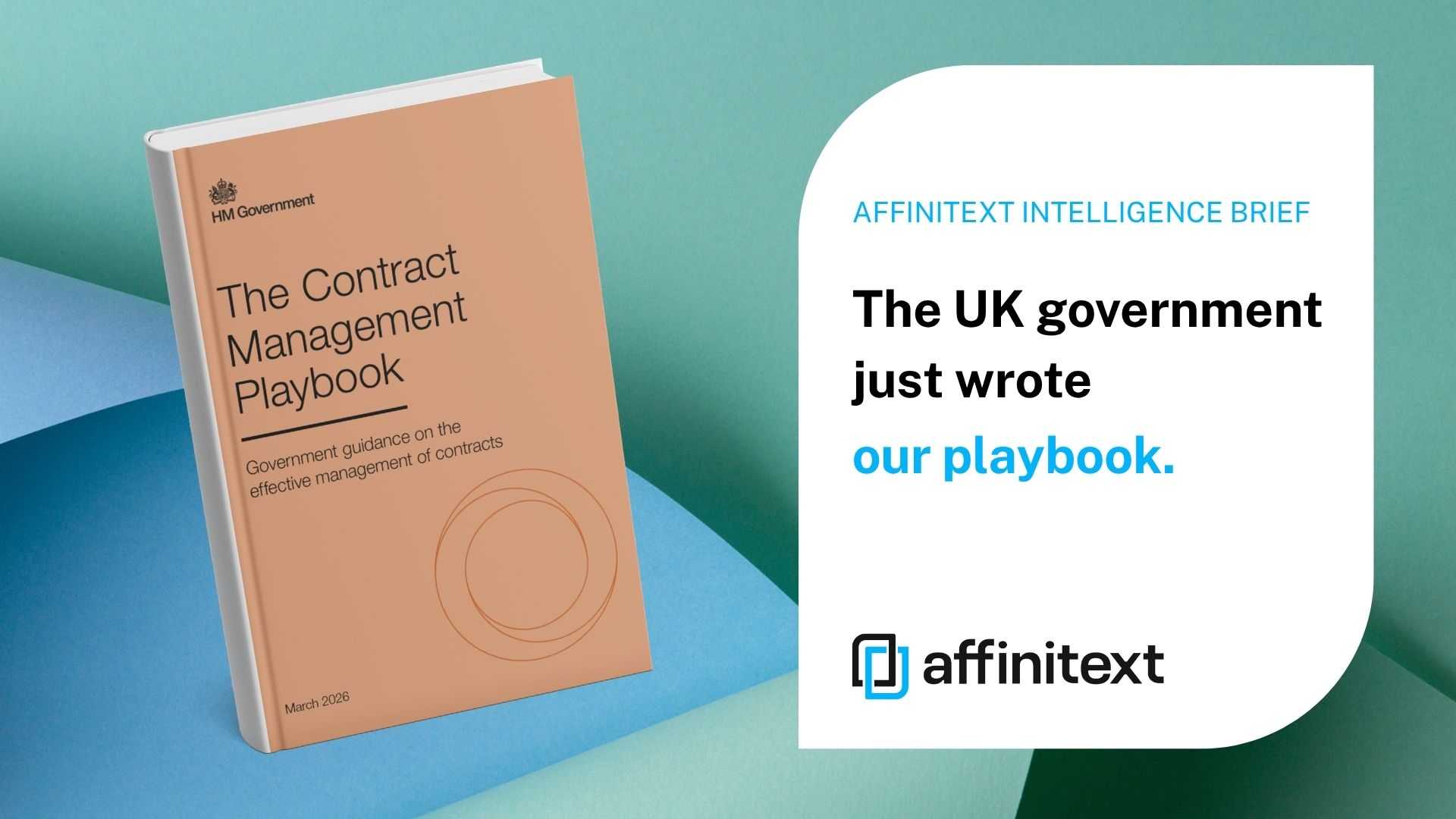
As of March 2026, the UK public sector holds 665 operational PFI contracts, representing £50bn worth of assets and £136bn in unitary charge commitments still to run. The National Infrastructure and Service Transformation Authority (NISTA) published those figures in its 2026 Foundations for Contract Managers guidance — and in the same week, published seven more documents covering every dimension of how those contracts should be managed.
This is the most comprehensive package of PFI contract management guidance the UK government has produced. It covers document stocktakes, gaps and ambiguities, governance frameworks, the Intelligent Client Function (ICF), contract review methodology, contract management plans, and contract management strategy. Each document is practical and operationally grounded.
The mandate it creates is clear. The roadmap it provides is detailed. The question it leaves open is the one that matters most: do contracting authorities have the contractual knowledge infrastructure to act on it?
Our read of the guidance is that, on current technology, most do not. Not because the teams lack skill or intent — but because the contracts themselves are not in a form that makes execution of this guidance tractable.
NISTA's Foundations guidance states plainly that a PFI contract is not a single document. It describes a typical PFI as comprising a project agreement and its key schedules — including the output specification, performance regime, payment mechanism, and handback provisions — plus all executed variations and relevant subcontracts. The guidance specifically instructs contract managers to "keep a version-controlled set of all executed variations and relevant subcontracts."
The Document Stocktake guidance goes further. It opens with a direct warning: "Over time, these documents may become outdated or misplaced. This increases the risk of relying on an incomplete or inaccurate document set." The consequences, the guidance states, include "missed opportunities such as overlooking favourable terms or strategic options in the contract."
The Gaps and Ambiguities guidance adds another layer. It identifies four categories of contractual problems that PFI teams must actively manage: missing documents, unaddressed matters, ambiguous terms, and unworkable provisions. It states that failure to manage these risks "can result in substandard service delivery, non-compliant assets (especially at expiry), increased costs, strained relationships and costly disputes."
"These requirements are often spread across multiple schedules and definitions, making them complex to navigate." — NISTA, Foundations for Contract Managers, 2026

That sentence from the Foundations guidance is the crux of the problem. The output specification — the document that defines what the contracting authority is paying for, and what it is entitled to deduct when standards fall short — is not a self-contained clause. It is a web of provisions distributed across the base agreement, multiple schedules, and years of executed variations. Each variation modifies something that came before. Some cross-references in the base agreement point to schedules that have themselves been amended. None of this is navigable in a document repository.
NISTA is not wrong about what needs to happen. The guidance is accurate and well-reasoned. The problem is that executing the guidance requires a level of contractual clarity that most teams cannot achieve with a folder of PDFs, however well organized.
The standard response to this challenge is one of three approaches: a document management system, a CLM platform, or a generic AI search tool applied to the contract files. None of them closes the gap the NISTA guidance describes.
Document management systems — SharePoint, file servers, even purpose-built contract repositories — address the storage problem, not the comprehension problem. They can confirm that a variation dated 2019 has been saved in the right folder. They cannot tell you what that variation changed, what provision it superseded, or what your current payment deduction entitlement actually is. The NISTA stocktake guidance calls for parties to verify they are "working from the same, up-to-date set of documents." A document management system can verify document presence; it cannot verify contractual currency.
CLM platforms were built for pre-execution workflows — drafting, approval, signature, storage. Some have added post-execution modules for alerts and renewals. None of them were designed for the problem a 25-year-old PFI contract presents: a layered stack of instruments where the current contractual position is only knowable by reading everything together. A CLM platform holds documents. It does not hold the conformed contractual position those documents collectively create.
Generic AI tools — whether applied through a chat interface or an enterprise search platform — face a more fundamental constraint. Any AI operating on unstructured PFI contract documents is working with incomplete, unverified, potentially superseded input. If a 2017 variation amended Schedule 15 of the project agreement, and the AI is searching across individual documents rather than a conformed record, it may surface the original Schedule 15 provision and miss the amendment entirely. The output will be plausible. It will also be wrong. For a contracting authority applying deductions under a payment mechanism, or preparing for handback, "plausible but wrong" is not a safe operating position.
The NISTA guidance describes, with precision, what the contractual knowledge base needs to contain: every executed variation, all relevant subcontracts, the full output specification with all amendments applied, the payment mechanism in its current form, and the handback provisions. It describes this as a management requirement. Our position is that it is an engineering requirement — and it requires an engineering solution.
AffiniCore takes the full contract stack — the base agreement, every amendment, every schedule, every annexure, every referenced document — and conforms it into a single, structurally parsed dataset. It does not index documents. It absorbs the entire contractual relationship into one unified record in which every amendment has been applied, every cross-reference resolved, and every defined term anchored to its definition. The result is a structured representation of what the contract currently says and requires — not what it said when it was signed.
This is the specific problem the NISTA Foundations guidance identifies when it warns that output specification requirements are "often spread across multiple schedules and definitions, making them complex to navigate." AffiniCore is the process of making that navigation tractable. Without it, any work done against the NISTA guidance framework is being done against an incomplete or unverified contractual picture.
AffiniAI then traverses that noise-free, structurally parsed record to surface answers users can navigate and validate at the source — not a probabilistic search across unstructured documents. When a contract manager needs to know the current deduction threshold for a category of service failure, AffiniAI traverses the conformed record and surfaces the answer with the clause reference and amendment history that supports it. The user navigates to the source. The answer is auditable.
The Intelligent Client Function guidance states that "a well-functioning ICF is embedded in governance, aligned with strategy and plans, and supported by the right people and tools." The tools part of that statement is where most authorities are currently exposed. The NISTA guidance tells you what to do. AffiniCore and AffiniAI give you the contractual foundation to do it from.
The NISTA Document Stocktake guidance recommends beginning a stocktake at least seven years before contract expiry. The Foundations guidance states that expiry planning should begin at the same horizon. With the earliest PFI contracts now inside that window, the question of whether your contractual knowledge base is fit for purpose is not a future consideration.
Three tests are worth applying to your current position. First: if the PFI Co raised a dispute about a deduction you applied, how long would it take your team to locate, verify, and present the current contractual basis for that deduction — including all amendments? Second: could your team identify, from the contract stack, every obligation that falls on the contracting authority in the 18 months before expiry? Third: is your current document set version-controlled against all executed variations, as the NISTA guidance requires?
If any of those questions produces hesitation, the gap the NISTA guidance describes is present in your portfolio. Affinitext has completed this conformance process across hundreds of PFI projects in the UK and PPP projects globally, including a 12-project pilot currently running with NISTA. The evidence from that work is consistent: when the contractual foundation is properly conformed, everything the guidance calls for — performance monitoring, deduction enforcement, expiry planning, governance — becomes executable rather than aspirational.
The guidance has been published. The mandate is set. The question now is whether your technology is built for the contract you are actually managing — or for a contract that is easier to manage than the one you have.
1. NISTA, Foundations for Contract Managers, PFI Centre of Excellence, 2026 — https://www.gov.uk/government/collections/public-private-partnerships
2. NISTA, Document Stocktake Guidance, PFI Centre of Excellence, 2026 — https://www.gov.uk/government/collections/public-private-partnerships
3. NISTA, Gaps and Ambiguities in PFI Contracts, PFI Centre of Excellence, 2026 — https://www.gov.uk/government/collections/public-private-partnerships
4. NISTA, Intelligent Client Function, PFI Centre of Excellence, 2026 — https://www.gov.uk/government/collections/public-private-partnerships
5. UK Government, PFI and PF2 Projects: 2024 Summary Data — https://www.gov.uk/government/publications/pfi-and-pf2-projects-2024-summary-data






.jpeg)


