


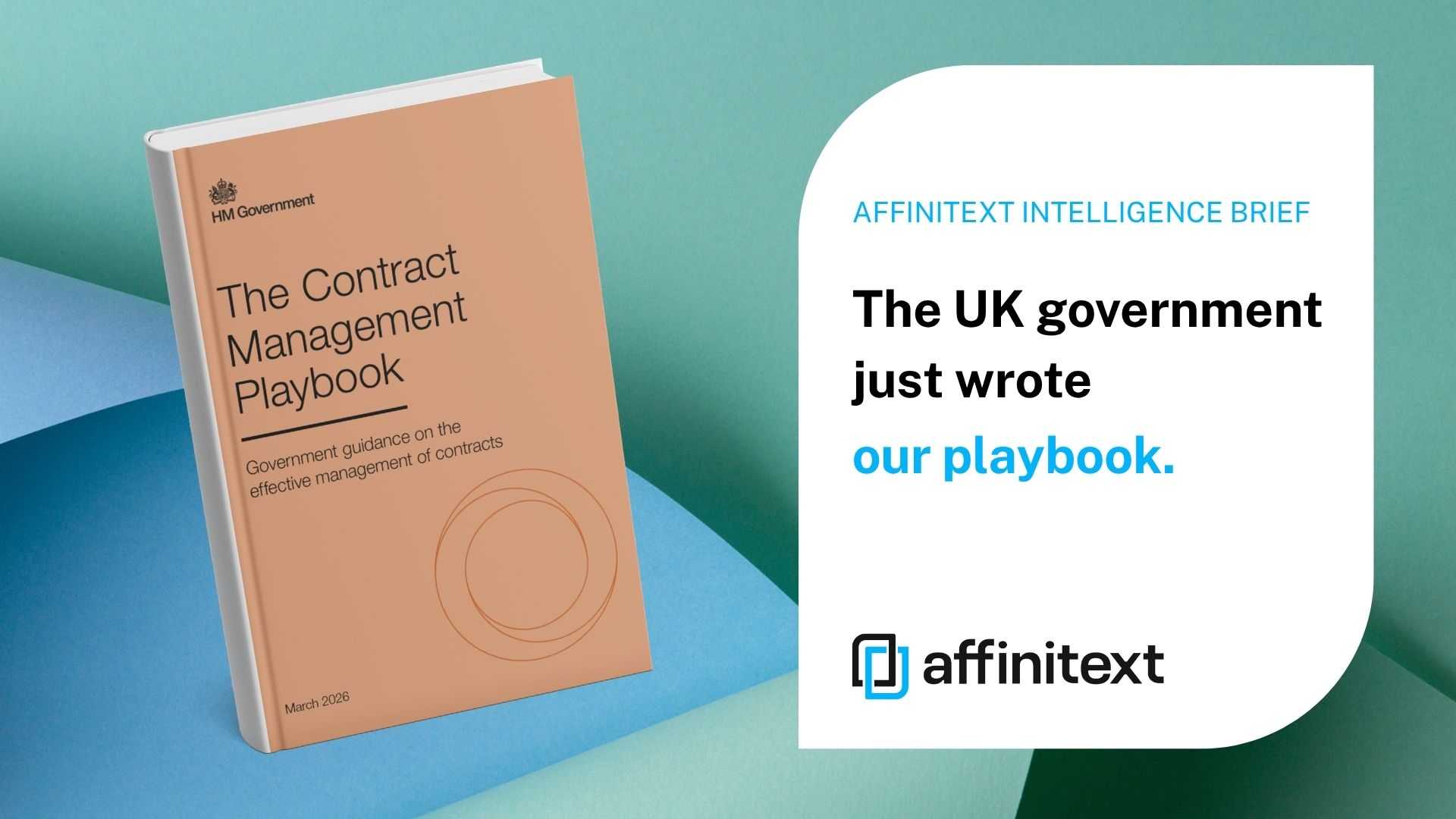
The UK Cabinet Office published its Contract Management Playbook in March 2026 — 92 pages of mandatory guidance designed to make 'let and forget' culture a thing of the past. The document is signed by the Government Chief Commercial Officer and the Director of Capability and People Services. It covers the full post-execution lifecycle: obligations tracking, performance management, change control, risk registers, and exit planning. It names failure modes that every infrastructure contract manager will recognise. It describes the tools required to prevent them.
Read it next to Affinitext's product architecture and the match is not approximate. It is exact.
"Around one-third of government spending is through contracts. These contracts deliver vital goods, works and services for public organisations... if these contracts are not managed effectively, the value achieved in procurement can be lost and benefits not realised."
— UK Cabinet Office Contract Management Playbook, March 2026
That is the problem Affinitext was built to solve. The Playbook is now the UK government's formal acknowledgment that the problem is systemic, the consequences are real, and the tooling required is specific.
The Playbook's diagnosis is direct: organisations have historically under-valued and under-resourced post-execution contract management. The result is a 'let and forget' culture in which contracts are filed rather than managed. Obligations go untracked. Change accumulates outside the contract record. Performance data lives in spreadsheets. The person who negotiated the deal is no longer in the role.
This is not a resourcing failure. It is a structural one. The Playbook calls for obligations matrices, change control registers, performance dashboards, and centralised auditable records — but does not resolve the prior question of how those outputs get produced from a 1,000+-page contract in the first place. That is Affinitext's diagnosis: without a structured, parsed foundation, every downstream activity — performance reporting, change control, risk management, exit planning — sits on unverified data. When something goes wrong, the audit trail does not exist.
The Playbook puts it plainly: 'Where parts of the contract management requirements are missed or delivery is disjointed, risks could materialise and opportunities to maximise value for money could be missed.' For a PPP / PFI or EPC contract worth hundreds of millions, that is not an abstract concern. It is the mechanism by which cost overruns begin and disputes become unavoidable.
The Playbook calls for a specific set of tools: obligations matrices, change control registers, risk registers, KPI trackers, contract management plans, and performance dashboards. It also calls for something harder to procure: the ability to understand what a contract actually requires.
That last requirement is where existing tooling fails. Contract lifecycle management platforms were built to manage documents — storing, versioning, and routing them through approval workflows. They do not parse obligations. They do not distinguish between a payment clause and a performance remedy. They do not know which clause governs a compensation event under an NEC contract versus a PPP concession agreement. They hold the file. They do not hold the knowledge.
Generic AI tools applied directly to PDF contract documents face a different but equally serious problem. They operate on unstructured source material. A 1,000-page infrastructure contract with annexures, schedules, and embedded technical specifications is not a document an AI search tool can reliably traverse. The Playbook explicitly identifies the risk: inconsistency between the contract record and the working reality of delivery. A tool that cannot distinguish the original term from an amendment, or a defined obligation from a general recital, will produce answers that look credible and carry real commercial risk.
The Playbook notes that records scattered 'across personal drives' and the absence of a 'centralised, auditable format' are root causes of governance failure. Storing documents centrally does not fix this. Structure fixes this.
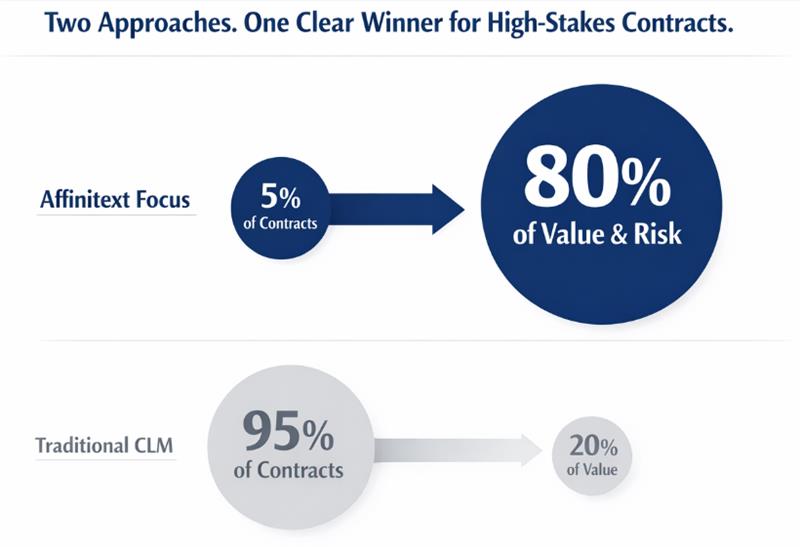
The Playbook is explicit that contract management effort should be proportionate to contract value, complexity, and criticality. It uses a tiering system — Gold, Silver, Bronze — to calibrate the level of governance, tooling, and expertise required. Gold contracts are the highest tier: the most critical, the most complex, the highest value. Every Gold contract requires a CMCP Expert-level accredited contract manager. Every Gold contract must have KPIs published quarterly. Every Gold contract demands active obligations tracking, change control, and performance management throughout its lifecycle.
Infrastructure contracts — PPPs, EPC agreements, concession contracts, giga-project delivery vehicles — are Gold tier by definition. These are the contracts where a single missed obligation can trigger a compensation event worth millions. Where a change not captured in the contract record creates a dispute that takes years to resolve. Where the difference between a functioning obligations matrix and a filing cabinet full of PDFs is a nine-figure exposure.
The Playbook's proportionality principle means the tooling must match the scale of risk. For Bronze contracts — routine, low-value, transactional — a spreadsheet may be proportionate. For Gold tier contracts that govern critical infrastructure and carry $500M+ in financial obligations, proportionate means a structured, parsed, auditable contract knowledge foundation. That is not a recommendation in the Playbook. It is a requirement.
Playbook Policy 6 — Proportionality:
"Contract management activities should be tailored to fit the specific needs of each contract, considering factors like size, value, criticality, and complexity."
For Gold tier infrastructure contracts, proportionate means AffiniCore-level structure. Not keyword search. Not document storage.
The Playbook's Policy 4 — 'Invest in appropriate tools, systems, and software' — specifies obligations matrices, change logs, contract management plans, and risk registers as non-negotiable infrastructure for effective contract management. These are not outputs of a good process. They are outputs of a system that has first converted the contract into structured, unified, high-quality, navigable knowledge.
That is precisely what AffiniCore does. It converts complex, high-value infrastructure contracts — PPPs, EPC agreements, concession contracts, NEC forms — into noise-free, structurally parsed datasets. Not a document repository. Not a search index. A structured representation of what the contract actually requires: every obligation, every milestone, every remedy mechanism, every defined term, in the correct hierarchical and cross-reference relationship.
AffiniAI then traverses that noise-free, structurally parsed dataset to surface answers users can navigate and validate at the source. Not a probabilistic search across unstructured PDFs. Not a summary generated from ambiguous input. A traversal of a contract that has already been understood — so that the answer to 'what are our performance obligations under Schedule 7 if the CPI adjustment mechanism is triggered?' comes back with a navigable, source-verifiable response, not a hallucinated approximation.
The Playbook describes what this enables: obligations tracking aligned to delivery schedules, change control that reflects the contract record, performance reporting against actual contractual KPIs, and audit trails that can survive a formal dispute. Affinitext customers managing UK Defence contracts delivered £10M in savings in 8 weeks. A Tier-1 contractor obtained $850K in additional revenue by identifying obligations the contract contained that the organisation was not enforcing. Both outcomes trace directly to the architecture the Playbook is now mandating.
The Playbook's six key objectives for contract management:
1. Delivering value and high-quality services
2. Effective governance
3. Knowledge sharing and collaboration
4. Digital transformation and cyber security
5. Innovation
6. Alignment with contract management standards
Every one of these objectives depends on the same prerequisite: a structured, trusted, navigable contract record.
If you are a Commercial Director, CFO, or project owner managing infrastructure contracts in the UK public sector, the Playbook is now mandatory guidance. Your Gold tier contracts require quarterly KPI publication, obligations tracking aligned to the Procurement Act 2023, structured change control, and an auditable contract management record. The Cabinet Office Contract Tiering Tool determines the classification. The Playbook determines what Gold tier demands. Neither leaves much room for interpretation.
If you are managing PPP contracts, EPC agreements, or giga-project concessions anywhere in the world, the Playbook describes the exact governance standard that protects your commercial position. The failure modes it identifies — obligations missed, change not captured, performance data unverified — are not UK-specific. They are the structural risks that produce cost overruns and disputes in every jurisdiction.
The question is not whether your organisation needs the capabilities the Playbook describes. It does. The question is whether the tools you have today can actually deliver them — or whether you are still relying on document storage and keyword search to manage obligations that carry nine-figure financial consequences.
Affinitext exists because the answer to that question, for most organisations, is still no.
Source: UK Cabinet Office Contract Management Playbook (March 2026)
https://www.gov.uk/government/publications/the-contract-management-playbook






.jpeg)


